

The Mathematical Foundations of Orthodontic Biomechanics
Orthodontics is inherently interdisciplinary, integrating principles from physics, mechanics, material science, and mathematics to achieve controlled tooth movement.
At Cephtactics, we recognise that predictable clinical outcomes rely on understanding forces, moments, ratios, and biological response — not simply appliance selection. By applying statistical modelling, probability analysis, and machine-learning–supported frameworks, we help clinicians develop a deeper theoretical appreciation of biomechanics alongside practical application.
This evidence-driven approach supports structured diagnosis, refined treatment planning, and more consistent clinical decision-making, reinforcing orthodontics as both a biological and mathematical science.
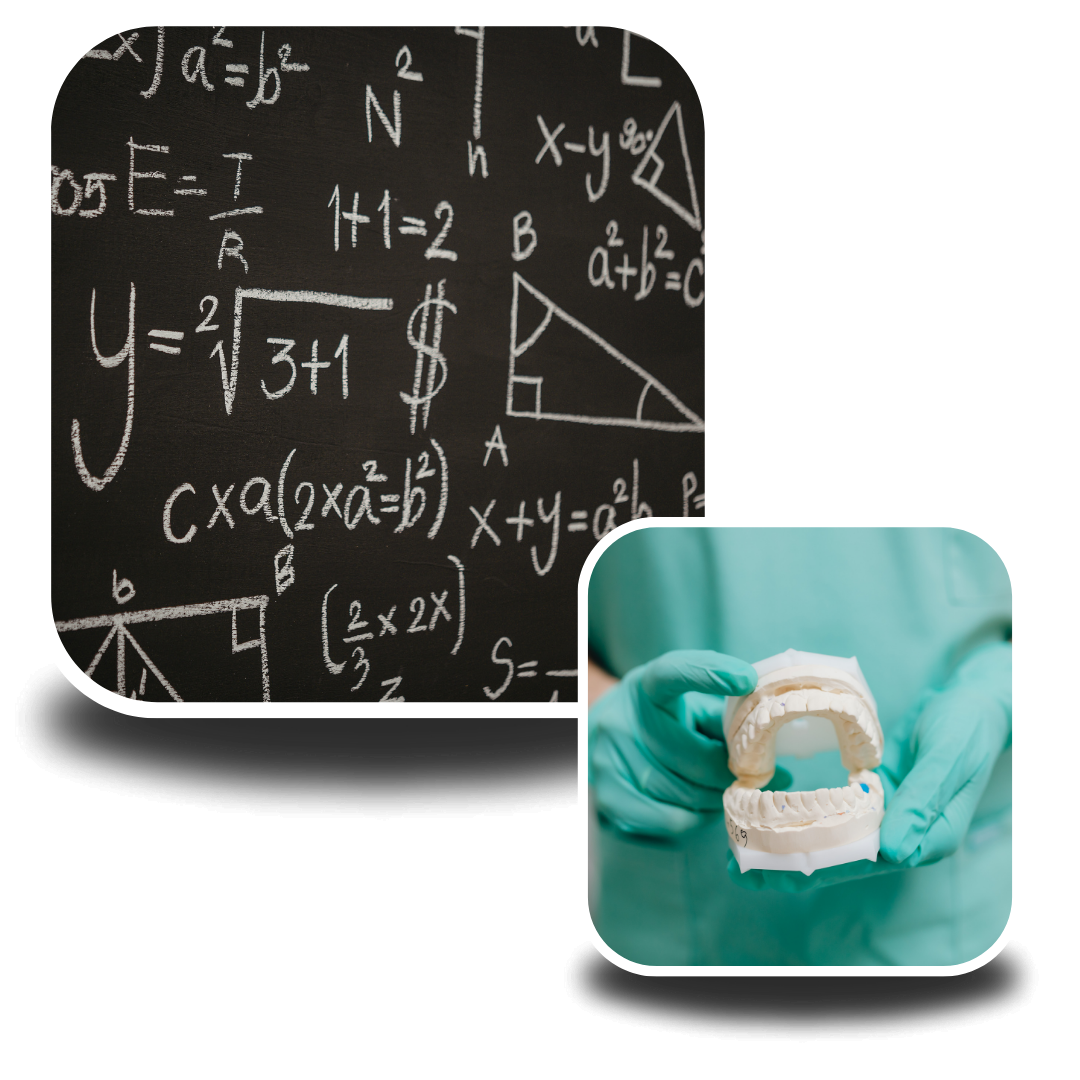
Why does mathematics matter to orthodontics?
Listen to mathematicians, policymakers, and educators and the answer seems unanimous: mathematics is everywhere, therefore every clinician should care about it.
The theoretical view within orthodontics
Orthodontics is a unique science in dentistry, which compares directly to many different fields. It is shown to gravitate more towards certain fields in other sciences than other forms of dentistry. Fields that are confluent in orthodontics which are relatively different when compared to others include metallurgy, physics and dynamics, mechanics and moments and the underlying components of mathematics bind them all together.
Understanding Orthodontics
The finite element method is invariably helpful, statistics, probability, machine learning and mathematical modelling, ratios and Knot Theory to name a few methods we utilise here at Cephtactics.